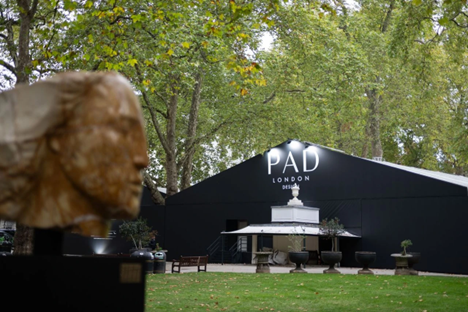
PAD London 2025:
Reflections from Art Advisor Polina Surina
PAD London 2025 revealed itself as a system of meanings where aesthetics and ideas converge.
Space acquired breath, material acquired memory, and light became a means of storytelling. This was not merely an exhibition of objects, but a reflection on how we inhabit light, silence, and form. Form itself became secondary, yielding to atmosphere and thought. The pavilion felt alive; light shifted throughout the day, while exhibitors worked with space as a medium, weaving together architecture and nature. The renewed appreciation for craftsmanship, handwork, and natural materials was unmistakable. Today, people are searching for what feels genuine, tactile, and alive.
Light, Material, and Quiet Precision
Charles Burnand and Maison Jaune Studio presented architectural studies in light and materiality. Bronze, wood, and glass spoke in a restrained yet articulate language—without spectacle, yet rich with internal rhythm.
At Booroom Gallery, the Dubai-based gallery with Russian roots, a rare Canoa armchair by José Zanine Caldas from his Móveis Denúncia (“Protest Furniture”) series stood alongside glass works by Kseniia Breivo inspired by George Balanchine’s ballet Jewels. Together, they formed a dialogue between sculptural presence and poetic movement.
Modernism Reconsidered
Portuondo Gallery created a compelling balance between modernism and craftsmanship. Reed, warm timber, and mid-century geometries appeared without nostalgia, unfolding instead in a measured and contemporary rhythm.
At Brussels-based Objects with Narratives, bronze and mineral forms functioned as structures of silence. Their works did not merely decorate the stand; they established a psychological atmosphere. It felt like an archaeology of the future, where weight, memory, and time acquire an entirely new material expression.
The Return of Presence
At the centre of the Meubles et Lumières stand stood Maurice Marty’s Carré de détente sofa, commissioned in the 1970s for Parisian collectors. A unique piece, it seemed to unite architectural structure with the hand of its maker.
Its soft contours and nuanced palette of warm beige created a feeling of genuine calm—not exhibition calm, but lived serenity. It embodied a form of retro-futurism free from nostalgia: a return to sensation, physical comfort, and trust in the passage of time. Its sculptural silhouette was irresistible. On the opening day visitors were still allowed to sit on it—and naturally, I did. Shortly afterwards, a sign appeared politely requesting otherwise.
Glamour as Cultural Memory
The presentation by Willy Rizzo explored glamour as a form of collective memory. Brass, velvet, and photographs of Brigitte Bardot and Salvador Dalí transformed the stand into something cinematic—an interior conceived as a still frame from another era.
At Adrian Sassoon Gallery, leading artists working in glass and ceramics created surfaces that appeared almost fluid, capturing the movement of light and air. A remarkable sculpture by Bouke de Vries became one of the fair’s earliest successes, finding a collector within the first fifteen minutes of opening.
Design Beyond Spectacle
Galerie Pradier-Jeauneau and JCRD Design continued the conversation around natural proportion and material plasticity. Their presentations were composed, precise, and free of unnecessary declarations.
What mattered here was not impact, but attentiveness—to the object, to time, and to light.
At PAD, objects became points of contact: portals into different states of perception and presence.
For me, as a curator working at the intersection of art, architecture, and spatial experience, PAD London is not simply a fair. It is a laboratory of ideas.
Contemporary collectors are increasingly searching not for objects, but for states of being—for harmony between the individual and the environment they inhabit.
PAD once again reminded us that design is neither a market category nor a trend. It is a language through which culture speaks to the world.
When form acquires meaning, space begins to breathe—and, in turn, reflect those who inhabit it.