The Length of an Aftertaste
Why the Most Important Projects of Biennale Arte 2026 Were Not the Loudest Ones
Every Venice Biennale produces a handful of projects that immediately command collective attention. They establish the rhythm of the opening days - visually, politically, emotionally. This year, those projects included the Austrian Pavilion, Pussy Riot’s interventions, the Russian Pavilion, and the strikes that accompanied the opening.
All of these moments matter. The most spectacular gestures capture the spirit of a particular moment with remarkable precision. Yet they are often the first to fade.
Other projects operate differently. They do not demand an immediate reaction. Their strength reveals itself later - after dozens of pavilions, receptions, journeys across the lagoon, and countless conversations when it becomes clear what truly remains.
Perhaps this is what Biennale Arte 2026 will ultimately be remembered for: not for its first impressions, but for the longevity of its internal resonance.
Venice heightens this sensation. It emerges in the dim, elongated passageways of the Arsenale, where, after a succession of visually saturated exhibitions, one suddenly encounters a rare sense of concentration and clarity. It returns during evening boat rides through the canals, when the city slows its pace and the works begin to reorganize themselves in memory not according to their volume, but according to their weight.
During the Biennale, Venice exists not only within its exhibition spaces but also in its boats, walkways, late dinners, and unexpected conversations. At The Gritti Palace, a discussion about art gradually transforms into a conversation about time, memory, and the experience of space itself.
Against this backdrop, one begins to notice something important: the most powerful environments are often not the most conspicuous.
At AMA, where Tino Sehgal’s work is presented, almost nothing is imposed upon the viewer. There is nowhere to hide behind an image; only one’s own presence within the performance remains. These are precisely the experiences that return an hour later, a month later, years later. To me, this is what genuine art is.
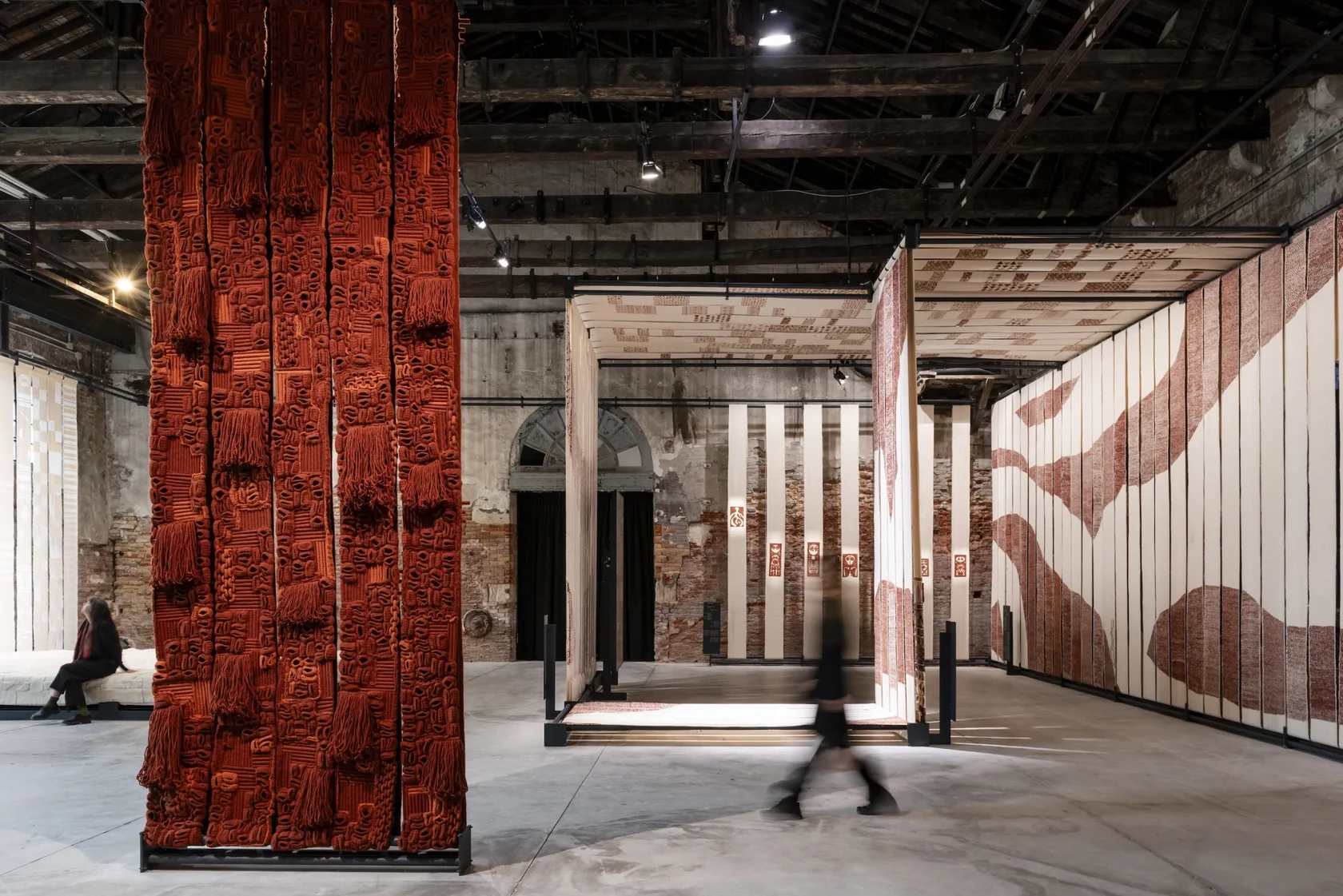
The Moroccan Pavilion functions in a similar way: not as an exhibition in the conventional sense, but as a space of memory and materiality.
The Lebanese Pavilion, featuring works by Nabil Nahas, unfolds through rhythm, layered surfaces, and an almost meditative sense of space. I first encountered Nahas’s work several years ago, and it entered our collection shortly thereafter. It is therefore particularly compelling to witness how his visual language resonates today within the context of the Biennale not as a personal discovery, but as one of the strongest artistic voices of this edition.
The Ding Yi project at Fondazione Querini Stampalia, curated by Auronda Scappin and Alfredo Cramerotti, develops as a sequence of pauses, signs, and surfaces. Here, water, memory, and physical presence become especially tangible. The Maltese Pavilion speaks in an even quieter register—and for that very reason remains unforgettable.
The same principle applies to the major institutional exhibitions.
Pinault Collection may possess less outward spectacle than the most discussed national pavilions, yet it offers greater depth. At Fondazione Prada, Helter Skelter places Arthur Jafa and Richard Prince in direct dialogue, transforming the exhibition space from a showcase into a charged field of images and memory.
At Palazzo Manfrin, Anish Kapoor demonstrates that monumentality need not operate through scale or noise. Instead, it emerges through an almost absolute density of presence.
Even where visitors arrive with few expectations, what proves most powerful is not the event itself, but the journey through it.
In Still Joy – From Ukraine into the World, presented by PinchukArtCentre, meaning unfolds through movement from one environment to another, through shifts in emotional registers and gradual immersion. Ryan Gander’s works become part of this broader internal trajectory. It is no coincidence that his work is also represented in our collection: what matters in these pieces is not immediate impact, but the endurance of their emotional resonance.
The Israeli Pavilion, Rose of Nothingness by Belu-Simion Fainaru, is structured around black water, droplets, and contemplative emptiness, transforming a politically charged space into a rare environment of calm and concentration.
Perhaps this is where the essential lesson lies.
Visibility has become an inexpensive form of presence.
This extends far beyond contemporary art. The same phenomenon has long been evident in architecture, hospitality, and cultural institutions. Interiors conceived solely around visual impact age as quickly as exhibitions designed only to generate attention. By contrast, places grounded in precision, materiality, and atmosphere often outlive their own media cycle.
And then a simple truth becomes visible:
Value is not determined by the strength of a first impression, but by the length of its aftertaste.
The loudest voices are almost always noticed first.
But what is truly meaningful begins where the noise ends.
Why the Most Important Projects of Biennale Arte 2026 Were Not the Loudest Ones
Every Venice Biennale produces a handful of projects that immediately command collective attention. They establish the rhythm of the opening days - visually, politically, emotionally. This year, those projects included the Austrian Pavilion, Pussy Riot’s interventions, the Russian Pavilion, and the strikes that accompanied the opening.
All of these moments matter. The most spectacular gestures capture the spirit of a particular moment with remarkable precision. Yet they are often the first to fade.
Other projects operate differently. They do not demand an immediate reaction. Their strength reveals itself later - after dozens of pavilions, receptions, journeys across the lagoon, and countless conversations when it becomes clear what truly remains.
Perhaps this is what Biennale Arte 2026 will ultimately be remembered for: not for its first impressions, but for the longevity of its internal resonance.
Venice heightens this sensation. It emerges in the dim, elongated passageways of the Arsenale, where, after a succession of visually saturated exhibitions, one suddenly encounters a rare sense of concentration and clarity. It returns during evening boat rides through the canals, when the city slows its pace and the works begin to reorganize themselves in memory not according to their volume, but according to their weight.
During the Biennale, Venice exists not only within its exhibition spaces but also in its boats, walkways, late dinners, and unexpected conversations. At The Gritti Palace, a discussion about art gradually transforms into a conversation about time, memory, and the experience of space itself.
Against this backdrop, one begins to notice something important: the most powerful environments are often not the most conspicuous.
At AMA, where Tino Sehgal’s work is presented, almost nothing is imposed upon the viewer. There is nowhere to hide behind an image; only one’s own presence within the performance remains. These are precisely the experiences that return an hour later, a month later, years later. To me, this is what genuine art is.
The Moroccan Pavilion functions in a similar way: not as an exhibition in the conventional sense, but as a space of memory and materiality.
The Lebanese Pavilion, featuring works by Nabil Nahas, unfolds through rhythm, layered surfaces, and an almost meditative sense of space. I first encountered Nahas’s work several years ago, and it entered our collection shortly thereafter. It is therefore particularly compelling to witness how his visual language resonates today within the context of the Biennale not as a personal discovery, but as one of the strongest artistic voices of this edition.
The Ding Yi project at Fondazione Querini Stampalia, curated by Auronda Scappin and Alfredo Cramerotti, develops as a sequence of pauses, signs, and surfaces. Here, water, memory, and physical presence become especially tangible. The Maltese Pavilion speaks in an even quieter register—and for that very reason remains unforgettable.
The same principle applies to the major institutional exhibitions.
Pinault Collection may possess less outward spectacle than the most discussed national pavilions, yet it offers greater depth. At Fondazione Prada, Helter Skelter places Arthur Jafa and Richard Prince in direct dialogue, transforming the exhibition space from a showcase into a charged field of images and memory.
At Palazzo Manfrin, Anish Kapoor demonstrates that monumentality need not operate through scale or noise. Instead, it emerges through an almost absolute density of presence.
Even where visitors arrive with few expectations, what proves most powerful is not the event itself, but the journey through it.
In Still Joy – From Ukraine into the World, presented by PinchukArtCentre, meaning unfolds through movement from one environment to another, through shifts in emotional registers and gradual immersion. Ryan Gander’s works become part of this broader internal trajectory. It is no coincidence that his work is also represented in our collection: what matters in these pieces is not immediate impact, but the endurance of their emotional resonance.
The Israeli Pavilion, Rose of Nothingness by Belu-Simion Fainaru, is structured around black water, droplets, and contemplative emptiness, transforming a politically charged space into a rare environment of calm and concentration.
Perhaps this is where the essential lesson lies.
Visibility has become an inexpensive form of presence.
This extends far beyond contemporary art. The same phenomenon has long been evident in architecture, hospitality, and cultural institutions. Interiors conceived solely around visual impact age as quickly as exhibitions designed only to generate attention. By contrast, places grounded in precision, materiality, and atmosphere often outlive their own media cycle.
And then a simple truth becomes visible:
Value is not determined by the strength of a first impression, but by the length of its aftertaste.
The loudest voices are almost always noticed first.
But what is truly meaningful begins where the noise ends.