“And All That Is In Between”: The Magnificent Islamic Arts Biennale 2025 in Jeddah
In recent years, the Islamic Arts Biennale in Saudi Arabia has established itself as one of the most significant and compelling events on the international cultural calendar. As someone who rarely misses a major exhibition, I simply could not pass up the opportunity to experience it firsthand.
For me, a biennale is about ideas, people, space, and the ability to communicate meaning. Credit is due to curators Julian Raby, Amin Jaffer, Abdul Rahman Azzam, and Saudi artist Muhannad Shono, who have accomplished this with remarkable clarity and sophistication.
Saudi Arabia today is defined by vision, ambition, and a profound respect for its historical roots. Equally important is its commitment to dialogue and cultural exchange—a quality that was evident everywhere I travelled, from Riyadh and AlUla to Jeddah itself.
The venue alone is extraordinary. The Western Hajj Terminal, originally designed by OMA, combines lightness, elegance, and a remarkable sense of openness. It is a place that inspires creativity, reflection, and possibility. At its heart sits a magnificent open-air amphitheatre hosting lectures, presentations, and public discussions throughout the Biennale.
What surprised me most was the sheer number of familiar faces in attendance—curators, gallerists, collectors, and artists, several of whom are represented in our own collections.
There was a particular satisfaction in recognising artists we had identified years ago now participating in one of the region’s most ambitious cultural events. Equally impressive was the presence of leading academics, curators, and mediators, who could be found throughout the Biennale engaging visitors in thoughtful and meaningful conversations.
As for the art itself, choosing favourites proved almost impossible. Even works that initially appeared deceptively simple revealed unexpected layers of meaning upon closer examination.
I always try to approach exhibitions with an open mind, uninfluenced by prevailing opinions. Yet on this occasion, my impressions frequently aligned with those of the experts.
Musalla: A Space of Light and Reflection
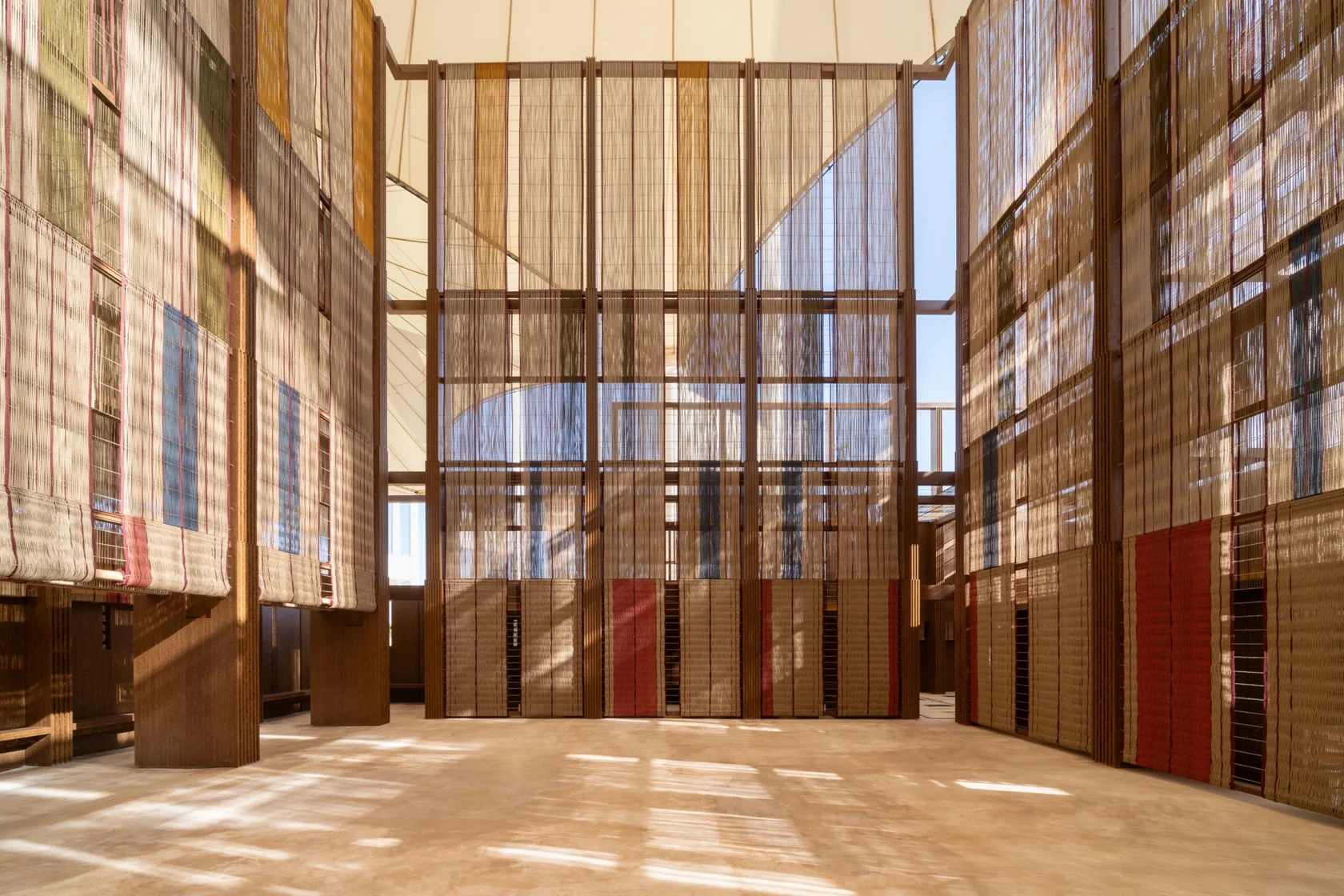
Among the most memorable projects was the ethereal prayer space Musalla, created by EAST Architecture in collaboration with artist Rayyane Tabet and engineering firm AKT II.
Elegant in form and rich in conceptual depth, the structure balances architecture, spirituality, and materiality with remarkable sensitivity. It was a pleasure to meet the creators of this award-winning project and discuss the ideas behind it. The installation exemplifies how contemporary design can engage tradition without reducing it to symbolism.
Mehdi Moutashar’s Alidade
Another standout was Alidade by Mehdi Moutashar, presented by one of my favourite galleries from the Far East.
Conceived as an architectural gateway, the work invites visitors to navigate multiple perspectives before converging at a central point, mirroring the physical experience of orientation and discovery.
The installation is elegant and understated, yet simultaneously powerful and intellectually resonant—proof that simplicity can often carry the greatest depth.
Nasrin Naseri’s Echo of the Sky
I was equally captivated by Nasrin Naseri’s poetic installation Echo of the Sky.
Inspired by twelfth-century Persian poetry and the mythical journey of birds seeking the divine Simurgh, the work combines references to Islamic architectural traditions with reflections on spiritual enlightenment and collective unity.
Its quiet presence encouraged contemplation, inviting visitors to consider the relationship between individual experience and universal meaning.
Imran Qureshi’s Oasis Between Mecca and Medina
One of the Biennale’s most immersive experiences was Imran Qureshi’s monumental octagonal nylon installation positioned between the pavilions dedicated to Mecca and Medina.
A cross-shaped water channel runs through its centre, surrounded by vibrant greenery that evokes an oasis along the historic route between the two holy cities.
The atmosphere of harmony and stillness was genuinely captivating. At one point I found myself lying on the floor beneath the installation, joined by both an artist and a renowned curator. Together we surrendered to the work’s meditative environment, allowing ourselves to fully inhabit the experience.
Ahmed Mater’s Magnetism
Particular attention should also be given to Ahmed Mater’s celebrated installation Magnetism.
A cube-shaped magnet recalling the form of the Kaaba generates intricate patterns of metallic particles that visually echo the ritual circumambulation of pilgrims around Islam’s holiest site.
The work functions simultaneously as a reflection on Islamic culture and philosophy and as a broader meditation on attraction, movement, order, and harmony. Its ability to operate on both spiritual and universal levels makes it one of the Biennale’s most compelling pieces.
Asim Waqif’s Min Rukam
Finally, it would be impossible not to mention Min Rukam by Asim Waqif.
Constructed from woven bamboo, this interactive installation encourages visitors to participate directly, generating sounds and melodies through their movements.
Sophisticated and engaging, the project reflects the artist’s longstanding interest in sustainability, traditional craftsmanship, and the relationship between inherited techniques and contemporary technology. It demonstrates how innovation can emerge through dialogue with tradition rather than in opposition to it.
A Biennale Worth Experiencing
These highlights represent only a small part of what impressed me at the Islamic Arts Biennale 2025 in Jeddah.
What makes this event remarkable is not only the quality of the works presented, but the way architecture, scholarship, spirituality, contemporary art, and public dialogue are woven together into a coherent and deeply engaging experience.
Without hesitation, I would highly recommend visiting.